
How to Scale Intentionally: Avoiding Hustle Culture
As I write this, I'm sitting in Park City, Utah.

My husband is here. Both of my children are here. Their spouses are here. All four of my grandchildren are here. We're making memories, laughing together, hiking, playing games, and simply enjoying being together.
Just three weeks ago, I was in Italy, Croatia, and Greece with my mom, sister, and cousin.
As I look around, I realize something.
I've spent the last 30 years building a business so I could have moments like these.
This blog is for the younger entrepreneur who is just getting started. The one who is working late nights, sacrificing weekends, and chasing a dream that feels worth every ounce of effort.
I understand because I've been there.
In fact, I believe hustle is often necessary in the beginning.
Years 0-2 of a business are different. You're figuring things out. You're proving a concept. You're learning skills you don't yet have. You're wearing too many hats because there isn't anyone else to wear them.
That season requires sacrifice.
But somewhere along the way, hustle culture convinced entrepreneurs that working harder is always the answer.
It's not.
And if you're still operating in constant hustle mode years into your business, there may be a deeper issue that needs to be solved.
I know because I lived it.
For years, I worked on every vacation.
I would wake up at 5:00 a.m., work until noon, and then spend the afternoon with my family. At the time, I convinced myself it was balance. After all, I was still taking the trip.
But I wasn't fully present.
My mind was divided. My attention was divided. My priorities were divided.
I enjoyed the work. I still enjoy the work.
The problem wasn't that I loved building businesses.
The problem was that I was saying yes to work while simultaneously saying yes to family, and one of those commitments was getting shortchanged.
After all, what was the point of building a successful business if I wasn't fully present for the people I was working so hard for?
Around 2016, I realized there had to be a better way.
Instead of working through vacations, I started planning for vacations.
I delegated responsibilities.
I trained people.
I built systems.
I communicated in advance.
I prepared my team.
And then I left.
I cared enough about the business to build one that didn't depend entirely on me.
That's when I learned one of the most important lessons of entrepreneurship:
Scaling isn't about increasing effort. Scaling is about decreasing dependency.
If you're wondering whether hustle culture has become a trap in your business, here are four warning signs.
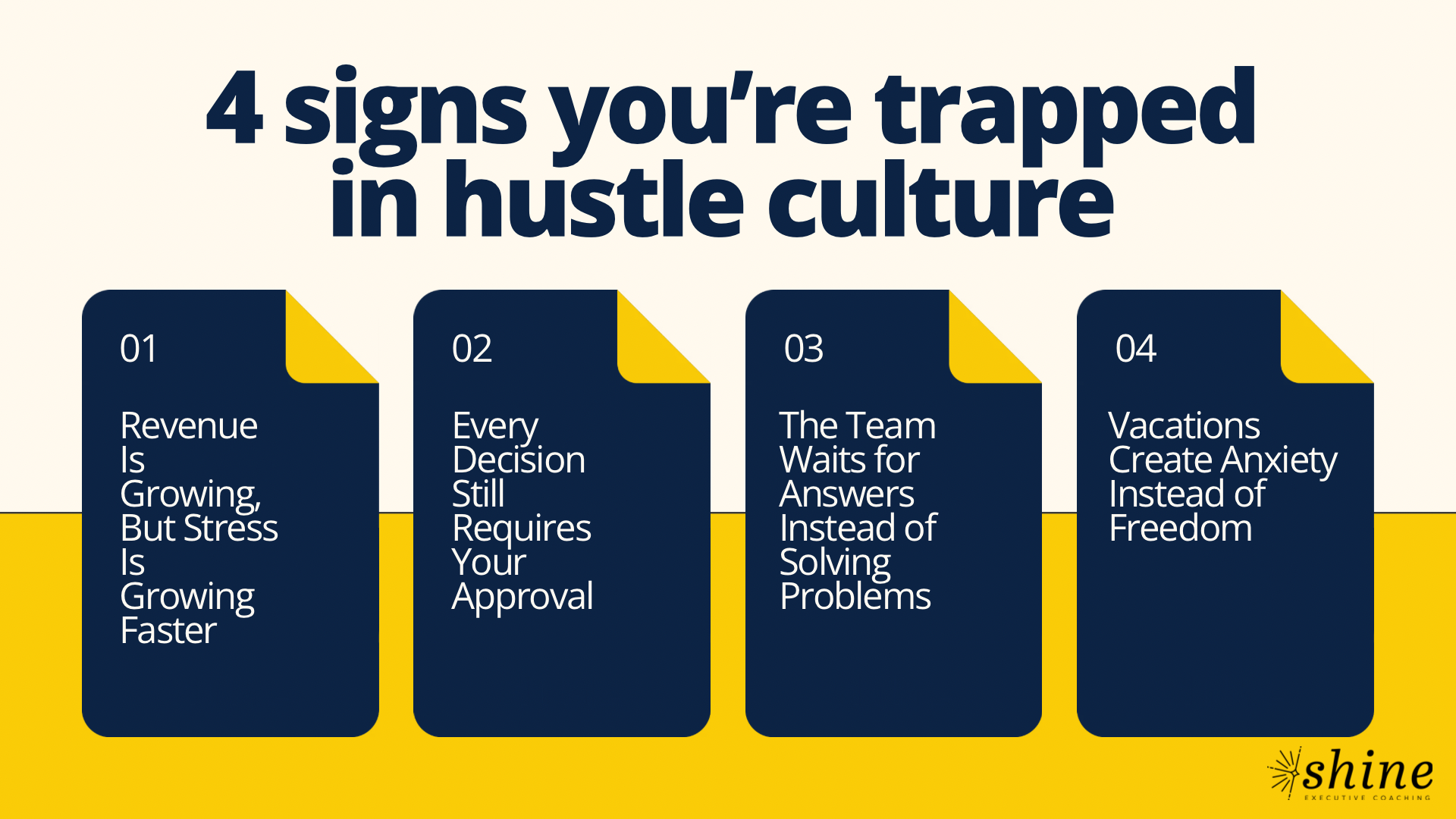
1. Revenue Is Growing, But Stress Is Growing
Growth should create opportunity.
If every increase in revenue creates an equal increase in stress, the business isn't scaling. It's simply demanding more from you.
A healthy business grows capacity alongside revenue.
An unhealthy business grows founder exhaustion.
2. Every Decision Still Requires Your Approval
If every question ends with someone saying, "Let me ask the owner," you've become the bottleneck.
Many founders wear this as a badge of honor.
It isn't.
A business that depends on one person to make every decision cannot scale for long.
3. The Team Waits for Answers Instead of Solving Problems
One of the greatest signs of maturity in a business is when team members start bringing solutions instead of problems.
If the team can't move forward without you, you've likely built dependence instead of leadership.
4. Vacations Create Anxiety Instead of Freedom
This one might sting.
If taking a week off feels impossible...
If your laptop always comes along...
If you're constantly checking messages...
If your family gets the leftovers after the business takes the best of you...
Something needs to change.
The goal of entrepreneurship isn't to build a business that owns you.
The goal is to build a business that serves the life you're trying to create.
Recently, my daughter came to me with a business idea.
I love the idea.
In fact, I think she would be incredibly successful at it.
For the last six months, she's talked about it, researched it, and dreamed about what it could become.
But one of the first conversations we had wasn't about revenue, marketing, or growth.
It was about reality.
Because entrepreneurship isn't nearly as glamorous as social media makes it look.
It's hard. It's lonely. It's risky. It requires sacrifice.
There are seasons where the business demands more than feels comfortable.
There are moments when no one else understands the weight you're carrying.
There are days when it feels like every problem eventually lands on your desk.
But if she's going to build something, I want her to build it intentionally.
I don't want her to accidentally create a business that consumes the very life she's trying to build.
That's the advice I'd give every entrepreneur reading this.
Work hard.
Be willing to sacrifice.
Do what the early years require.
But don't stay there forever.
Build systems.
Delegate responsibilities.
Develop leaders.
Create accountability.
Document processes.
Scale intentionally.

What Finally Changed for Me
The truth is, I didn't stumble into this way of operating.
I had to learn it.
Over time, I discovered that most entrepreneurs don't have a hustle problem.
They have a systems problem.
When the vision only lives in the owner's head, hustle fills the gap.
When priorities aren't clear, hustle fills the gap.
When roles are undefined, hustle fills the gap.
When there is no accountability, hustle fills the gap.
When processes aren't documented, hustle fills the gap.
When leaders aren't developed, hustle fills the gap.
The irony is that the harder most founders work, the more those problems get hidden.
Eventually, I realized there was a better way.
That's why I created Scale Secrets.
I kept meeting good entrepreneurs who were trapped inside businesses they had worked so hard to build.
Scale Secrets is simply the framework I wish someone had handed me years ago. It is a practical way to build clarity, accountability, leadership, and systems so the business can grow without requiring more and more of the owner's life.
The goal is to make sure your hard work creates freedom instead of dependency.
As I sit here in Park City surrounded by three generations of family, I'm reminded that success isn't measured only by what you've built.
It's also measured by what your business allows you to enjoy.
Shine Lesson Learned: The hustle season may be necessary. Living there forever is not. Build systems, develop leaders, and create accountability so the business can grow without demanding more and more of your life. The people you love most deserve more than the leftovers.
Shine On,
Shannon