
Your Next Great Hire Needs More Than a Job Description
A founder in my Execution Lab group coaching recently asked me a question I hear all the time.
She had just hired a new Director of Operations.
This was a huge milestone for her business. She had spent months searching for the right person, and she had found someone with years of leadership experience. He had managed teams, built systems, and had the résumé to prove it.

Then she asked me,
"How do I make sure he succeeds?"
Most people would expect my answer to be about onboarding.
Or KPIs.
Or weekly one-on-one meetings.
Instead, I told her a story.
A few months earlier, I had the opportunity to interview Rob Flanagan, CEO of Houndstown, for a franchising project I was working on. During our conversation, he shared something that has stuck with me ever since.
He told me they've hired brilliant people from outside the franchise industry.
Experienced marketers.
Experienced operators.
People who had been incredibly successful in previous roles.
Yet some of them struggled almost immediately.
Why?
Because they came into franchising treating franchisees like employees.
Or vendors.
Instead of independent business owners.
Rob laughed as he described the situation. These were smart people with great intentions, and they couldn't understand why franchisees were frustrated with them.
The experience transferred.
The mindset didn't.
When he said that, I immediately thought...
That's true in every business.
We assume that because someone has experience, they'll automatically know how to lead inside our company.
They won't.
Every business has its own culture.
Its own values.
Its own way of making decisions.
Its own definition of what "great leadership" looks like.
None of those things come with a job description.
That's when I looked back at the founder in my coaching session.
I told her, "Hiring the right person is only the first step. Now you have to teach him how you think."

Years ago, when I promoted the president of my company, she had already been with me for nearly twenty years.
Think about that.
Twenty years.
She knew our customers.
She knew our team.
She knew our systems.
She knew our business inside and out.
And we still met for two hours every week for the first six months after she stepped into that role.
People hear that and immediately think...
"I don't have time to do that with every employee."
Neither did I.
Because this wasn't about every employee.
This was about one key leader who would be making decisions when I wasn't in the room.
And here's the important part...
I wasn't teaching her the business.
She already knew the business.
I was teaching her how to think like the president.
Those meetings were filled with conversations like:
"Here's why I made that decision."
"Here's what I saw that wasn't obvious."
"Here's what I would prioritize first."
"Here's how I would handle this situation."
I wasn't transferring information.
I was transferring judgment.
That's what founders often miss.
Delegation is giving someone responsibility.
Leadership is teaching them how to use good judgment once they have it.
Before you think, "I don't have two hours a week for six months," let me ask you another question.
How much time does it take to fix six months of poor decisions?
How much time does it take to rebuild trust after a leader unintentionally damages your culture?
How much time does it take to undo habits that were never aligned with your vision in the first place?
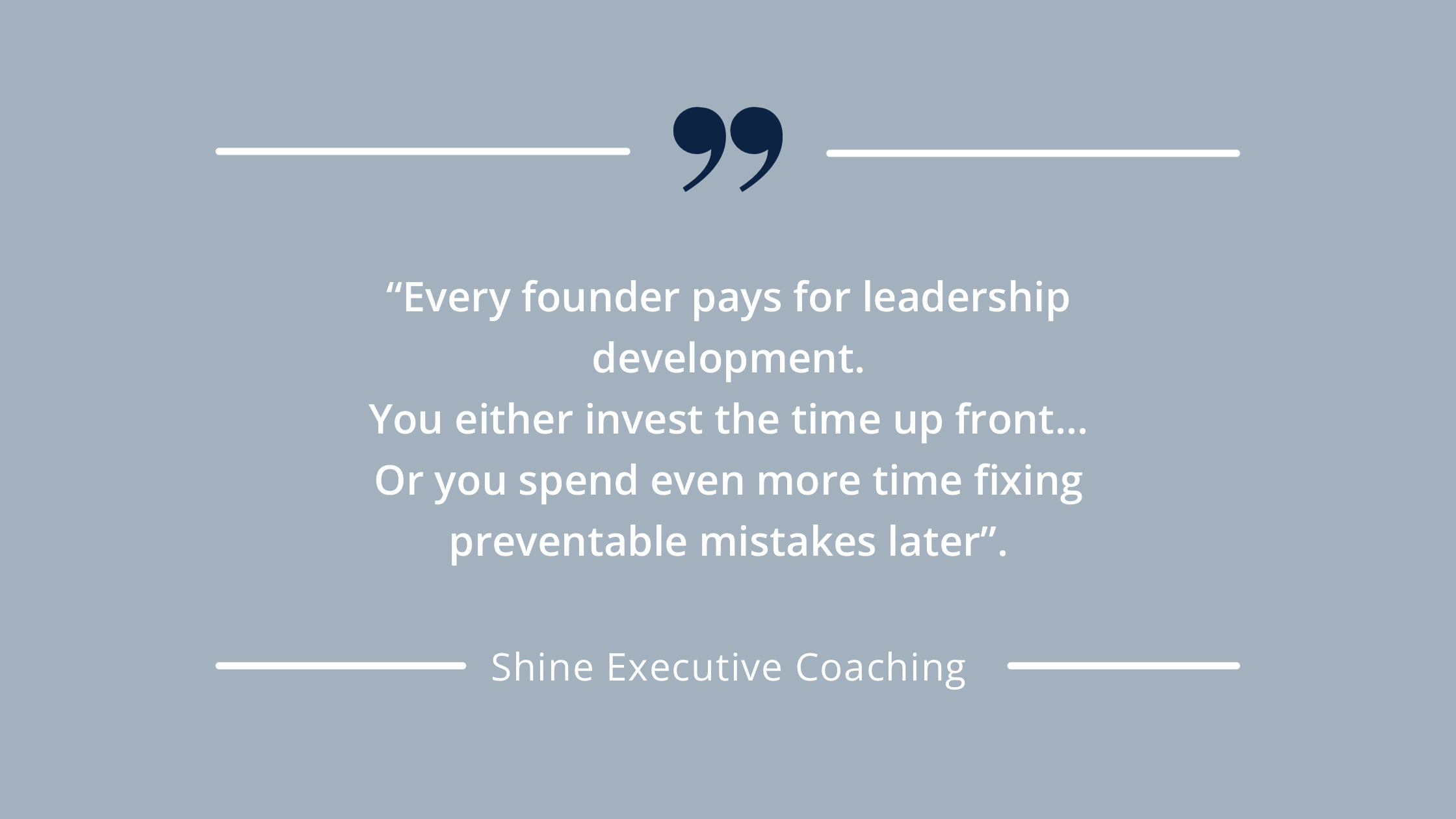
Every founder pays for leadership development.
You either invest the time up front...
Or you spend even more time fixing preventable mistakes later.
The goal isn’t to create leaders who constantly need you.
The goal is to create leaders who think well when you're unavailable.
And here's where I see so many founders get stuck.
They continue having the same leadership conversations over...
and over...
and over again.
The same coaching.
The same explanations.
The same lessons.
If you find yourself repeating something to every new leader, you've discovered something valuable.
It belongs in a system.
Those two-hour meetings with my president weren't designed to last forever.
As patterns emerged, we documented them.
We built leadership rhythms.
We created weekly Momentum Meetings.
We established quarterly planning sessions.
We documented expectations.
We built processes around the conversations every leader needed to have.
Eventually, the wisdom that once lived only in my head became part of the operating system of the company.
That's when leadership became scalable.
And this principle extends far beyond your leadership team.
If every Director of Operations needs to understand how you make decisions, build a leadership development process around it.
If every franchisee asks the same questions about running the business, create a quarterly rhythm where those conversations happen.
If every new executive needs coaching on your culture, your values, or your expectations, stop relying on one-on-one conversations alone.
Systemize it.
Your business shouldn't depend on your memory.
It should depend on your operating system.
The founders who scale aren't the ones who answer every question personally.
They're the ones who capture their wisdom, build it into systems, and create leadership rhythms that continue teaching long after they've left the room.
Shine Lesson Learned:
Experience transfers.
Judgment doesn't.
If you want your business to grow beyond you, your greatest responsibility isn't simply hiring great leaders. It's intentionally teaching them how to think, and then building systems that preserve that thinking for every leader who follows.
Shine On,
Shannon