
When a Yawn Becomes a Culture Problem
“Is yawning an issue?”
That was the question a client asked me recently during her weekly leadership meeting debrief.
Their team runs on EOS®, so every week they bring forward an Issues List. The Issues List is a place for anything that feels off: things that are working, broken, missing, confusing, or bothering someone on the team.
And that week, one teammate added this to the list:
“Yawning in meetings.”
At first my client thought it was silly.
Then she remembered something:
We had just finished a Culture Operationalization Exercise together, a signature piece of my Scale Secrets™ framework.
And because her team had taken the time to define their core values with observable behaviors, suddenly the yawning made perfect sense.
It wasn’t about the yawn.
It was about the culture.
Small Behaviors Reveal Big Values
This teammate wasn’t annoyed because yawning is rude (we all yawn!).
She was bothered because one of their core values is Positive Energy & Attitude (“We bring the good vibes”)
Earlier this year, we had operationalized that value together, clarifying:
What good looks like
What not living it looks like
How to observe the behavior in real time.
Here’s a snapshot of what we created as a team:
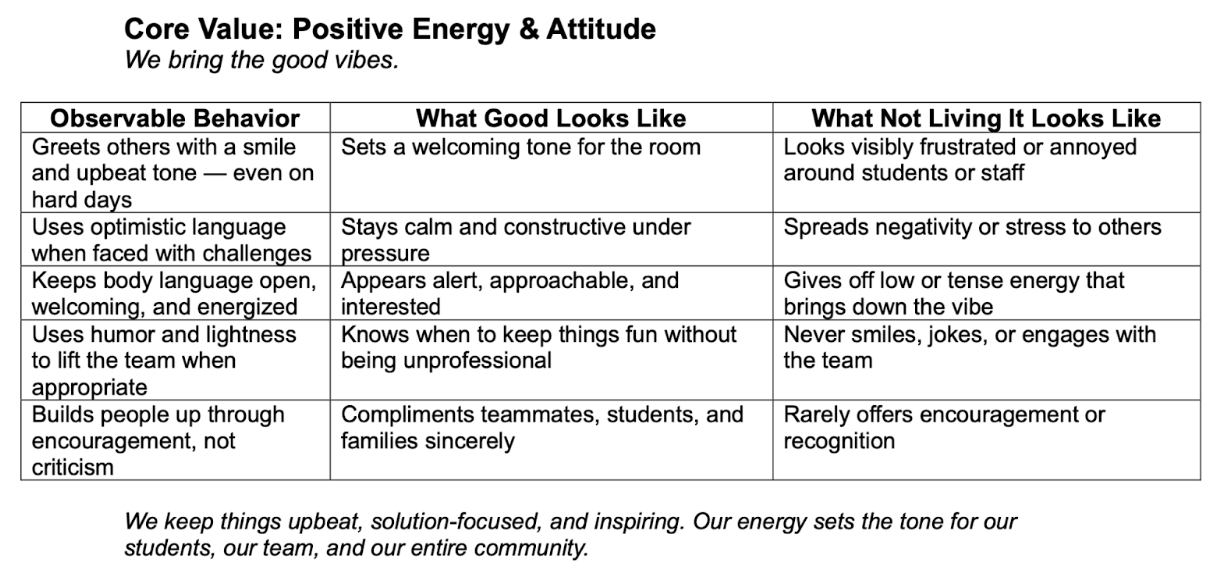
So when a team member consistently did these long, dramatic yawns in every meeting, even unknowingly, it broke alignment with the culture they all said they wanted.
It drained the room.
It clashed with the value.
It distracted the team.
And it mattered enough for someone to put it on the Issues List.
And this isn’t just my opinion as a coach, this is backed by data.
Here’s the thing: we’re not just talking about “a little annoyance” in a meeting. Workplace culture impacts people at a deep level, emotionally, mentally, and physically.
Harvard research shows that the average adult will spend 90,000 hours at work over their lifetime, and that a poor workplace culture can negatively affect wellbeing, reduce productivity, and increase turnover.
In contrast, employees who work in a positive, values-aligned culture are healthier, happier, and more productive, and those companies even see higher annual returns.

When It Makes the List, It Matters
One of my favorite leadership principles is simple:
Issues are neutral. People are not.
If someone brings something up, even something tiny, it deserves attention.
Because behind every small behavior is a bigger story:
“I don’t feel like we’re all showing up the same way.”
“I value energy, and I’m not seeing it.”
“This behavior doesn’t match who we said we want to be.”
“This distracts me and affects how I experience our culture.”
Small irritations become big resentments when ignored.
That’s why culture work matters so much.
When you’ve named your values, and you’ve defined what they look like in action, you suddenly have a shared language for accountability. It takes the emotion out of the feedback.
It becomes simple, not personal.
Culture Is Built (or Broken) in Micro-Moments
Leaders often think culture shows up in big statements, bold visions, and company offsites.
But having led and coached founders for over 20 years, I can tell you this with certainty:
Culture actually shows up in micro-moments.
It’s in:
how you walk into a meeting
the tone you bring
your body language
the energy you give off
the things you tolerate
the things you celebrate
the “little things” you decide are or are not okay
In this case, a yawn wasn’t about tiredness.
It was about misalignment.
And the team felt it.
What They Did Next
Using the operationalized core value, the conversation became easy:
Name the behavior
“When you yawn like that repeatedly in meetings…”Connect it to the value
“…it doesn’t align with our Positive Energy & Attitude core value.”Give space for the story
Maybe they were exhausted. Maybe overwhelmed. Maybe unaware.Clarify expectations
“We need everyone to show up with alertness and positive energy.”
Nobody got defensive.
Nobody felt attacked.
Everyone felt understood.
Because the standard was already set and visible.
Shine Lesson Learned
When you operationalize your core values, everything becomes clearer:
✔ What behavior aligns
✔ What behavior doesn’t
✔ How to hold others accountable
✔ How to keep your culture healthy
✔ How to ensure the right people are in the right seats
This is why culture work is one of my Scale Secrets™.
It’s part of the foundation I walk my clients through, because without a shared understanding of “how we show up,” you can’t scale well.
Whether it’s yawning, tone, body language, or communication style…
If it makes the Issues List, it’s an issue worth solving.
Because the small things?
They’re never small.
They’re culture.
Shine On,
Shannon