
Is Your Business Ready to Scale? Seven Signs It’s Time
I have conversations every week with founders who tell me they are ready to scale.
They are excited. They are ambitious. They are thinking about more locations, franchising, or expanding their team.
And I love that. Growth is a good thing.
But after more than twenty years of building and scaling a brand, I have learned something that does not get talked about enough.
Wanting to scale and being ready to scale are not the same thing.
Scaling does not fix a business. It magnifies it. Whatever is working will grow. Whatever is broken will grow faster.
Recently, I spoke with a founder who was doing around $200,000 in revenue. She was running everything herself and doing a great job. During our call, she said something that stood out to me. She told me she needed help with strategy and getting her thoughts organized.
I respected that level of awareness. It takes humility to say that out loud.
But what she needed was not scaling. She needed structure. She needed clarity. She needed to strengthen the foundation she had already built.

Not long before that, I met with a couple who had opened a brick-and-mortar concept. They were working hard to get it off the ground, and at the same time, they were asking about opening additional locations. The challenge was that their first location had not broken even yet. It was also a seasonal business, so they did not yet know if it would produce consistent cash flow.
Even so, they were considering investing another half a million dollars to expand.
That is the moment where experience has to step in.
Before you multiply something, you have to prove that it works.
What scaling actually means
Before we even talk about whether a business is ready to scale, it helps to understand what scaling really is.
Scaling goes beyond growth.
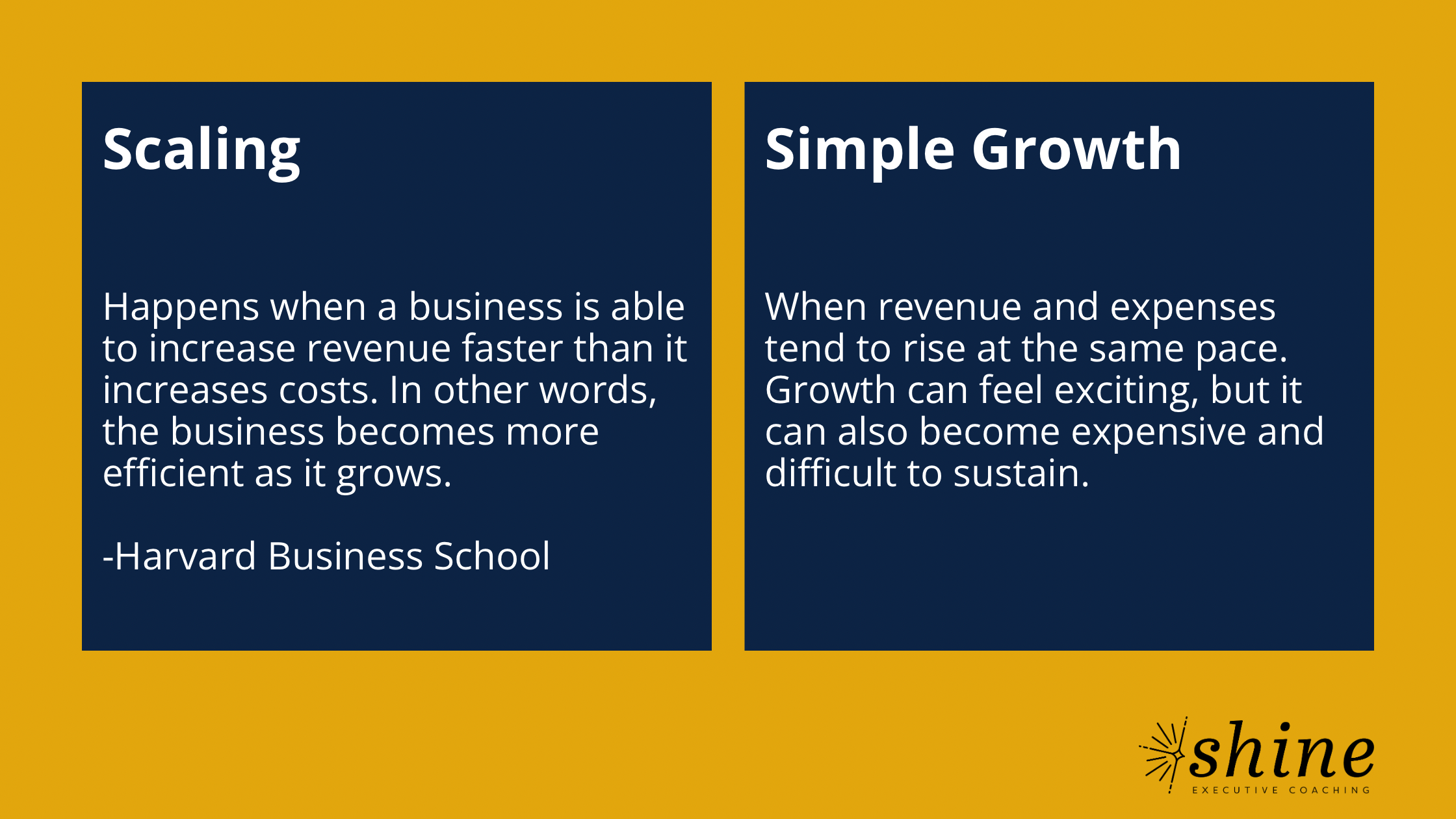
According to research from Harvard Business School, scaling happens when a business is able to increase revenue faster than it increases costs. In other words, the business becomes more efficient as it grows.
That is very different from simple growth, where revenue and expenses tend to rise at the same pace. Growth can feel exciting, but it can also become expensive and difficult to sustain.
This is where many founders get into trouble. They add more people, more locations, or more complexity before the business is designed to handle it.
And the stakes are real. Research has shown that more than half of businesses fail within five years, and the number climbs even higher over time - to over 70% after 10 years!
Scaling is not just about getting bigger. It is about building a business that can grow without breaking.
So how do you know if your business is actually ready to scale?
Here are seven signs I look for.
1. Your business is consistently profitable
Consistent profitability is non-negotiable.
I see this all the time. Founders point to growing revenue, but when you look under the hood, there is nothing left at the end of the month. That is not a scalable business. That is a stressful one.
You should understand your numbers, know your margins, pay yourself, and still have money left over. Profit is what fuels growth. It gives you options, allows you to reinvest, build your team, and make decisions from a place of strength instead of survival.
If your business is not consistently profitable, scaling will not fix it. But when it is profitable, you have something repeatable, and repeatability is what makes scaling possible.
2. You can clearly explain how your business works
If I asked you to explain your
business model, could you do it simply and clearly?
Not long. Not complicated. Simple.
I once met with a prospective client who wanted to franchise her business. I asked her, “Tell me about your business.” Thirty minutes later, she was still explaining, and I still was not sure what it was.
She was passionate and had built something real. But it was complex, layered, and difficult to explain. That made it nearly impossible to replicate well.
If people cannot quickly understand your business, they will not stick around long enough to do business with you.
Simplicity scales. Complexity kills.
3. You have systems, not just effort
In the early stages, effort carries the business. But that only works for so long.
I learned this in 2012 when a key team member left to home school her children, and we realized everything lived in her head. Nothing was documented and we were struggling for months the wake of her departure to figure out how to do things. It took multiple people to replace her, and even then, we were still piecing things together.
That moment changed how we operated.
We got serious about building systems.
Processes were documented.
Workflows were created
After all that work, the business no longer depended on one person to function.
Scaling requires systems, not just effort. Your business has to run without you being involved in everything.
If everything lives in your head (or an employee’s head), you do not have a scalable business. You have a dependent one.
A simple test is this. Step away for two weeks. If everything stops, your systems are not in place yet.
4. You are no longer the bottleneck
Many founders reach a point where every decision and problem runs through them. It feels productive, but it creates a ceiling.
I learned this in 2015 when my husband was diagnosed with cancer. We postponed a big anniversary trip to the following year, and when we finally took it, I wanted to be fully present. But I also knew being gone for 21 days would test the business.
For the most part, things held together while I was away. But weeks later, everything started to slip. Projects stalled, deadlines were missed, and important work sat untouched.
That is when it hit me. I was the bottleneck.
Everything still depended on me, even when I was not there. Growth exposed it.
That moment forced a shift. We built structure, empowered leaders, and gave the team real decision-making authority. I had to let go of control - and let my team have some autonomy in their areas of responsibility. It was hard, but it opened up new growth opportunities for us.
If your business cannot move forward without you, it is not ready to scale. More growth will not fix it. It will only increase the pressure.
Scaling requires letting go of control in the right areas and building a team that can operate without you.

5. Demand is already there
Scaling should respond to demand, not try to create it.
You are ready to grow when people are already asking for more than you can currently deliver. You may have a waitlist. You may be turning away opportunities. You may feel the strain of trying to keep up.
That is when expansion becomes a solution instead of a gamble.
Customer retention is doing the heavy lifting
One of the clearest indicators that a business is ready to scale is not just new customer growth, but repeat business.
Research consistently shows that even a small increase in customer retention can have a significant impact on profitability. In fact, improving retention by just 5 percent can increase profits anywhere from 25 percent to 95 percent. It is also widely cited that acquiring a new customer can cost five to twenty-five times more than keeping an existing one.
According to the U.S. Chamber of Commerce, these dynamics make customer retention one of the most powerful drivers of long-term growth. Read more from the U.S. Chamber of Commerce
What this means for founders is simple. If your current customers are coming back, spending more, and referring others, your business has momentum. That kind of loyalty creates stability, and stability is what allows you to grow with confidence.
6. You have access to capital and a plan to use it
Growth costs more than most people expect. (me included)
It is not just the obvious costs like buildouts, hiring, and operations. It is the unexpected ones. The delays. The mistakes. The learning curves that come with doing something for the first time.
I have seen founders underestimate this over and over again.
They think they are investing in growth, but what they are really doing is taking on risk they are not prepared for.
You need access to capital. But more importantly, you need a clear plan for how that capital will be used and how it will generate a return.
Because capital does not fix a broken model. It just allows you to make bigger mistakes faster.
When your foundation is strong, capital becomes a tool.
And in its absence, it becomes pressure.
7. Your vision is clear and compelling
Scaling is a leadership decision as much as it is a financial one
A clear vision gives the business direction. It defines where you are going, what matters most, and what kind of company you are trying to build. Without that clarity, growth can become reactive, scattered, and expensive.
McKinsey notes that healthy organizations are able to translate vision and strategy into clear, measurable objectives that are shared throughout the organization. When people understand the direction of the business, decision-making improves, priorities become clearer, and execution gets stronger.
You need to know why your business should grow, who it is meant to serve, and what impact you are trying to create. Because when growth gets hard, and it will, vision is what keeps you grounded and moving forward.
The real question
Scaling isn’t always the right next step
Sometimes the right move is to pause and strengthen what you have already built. That is not a step backward. It is what makes sustainable growth possible.
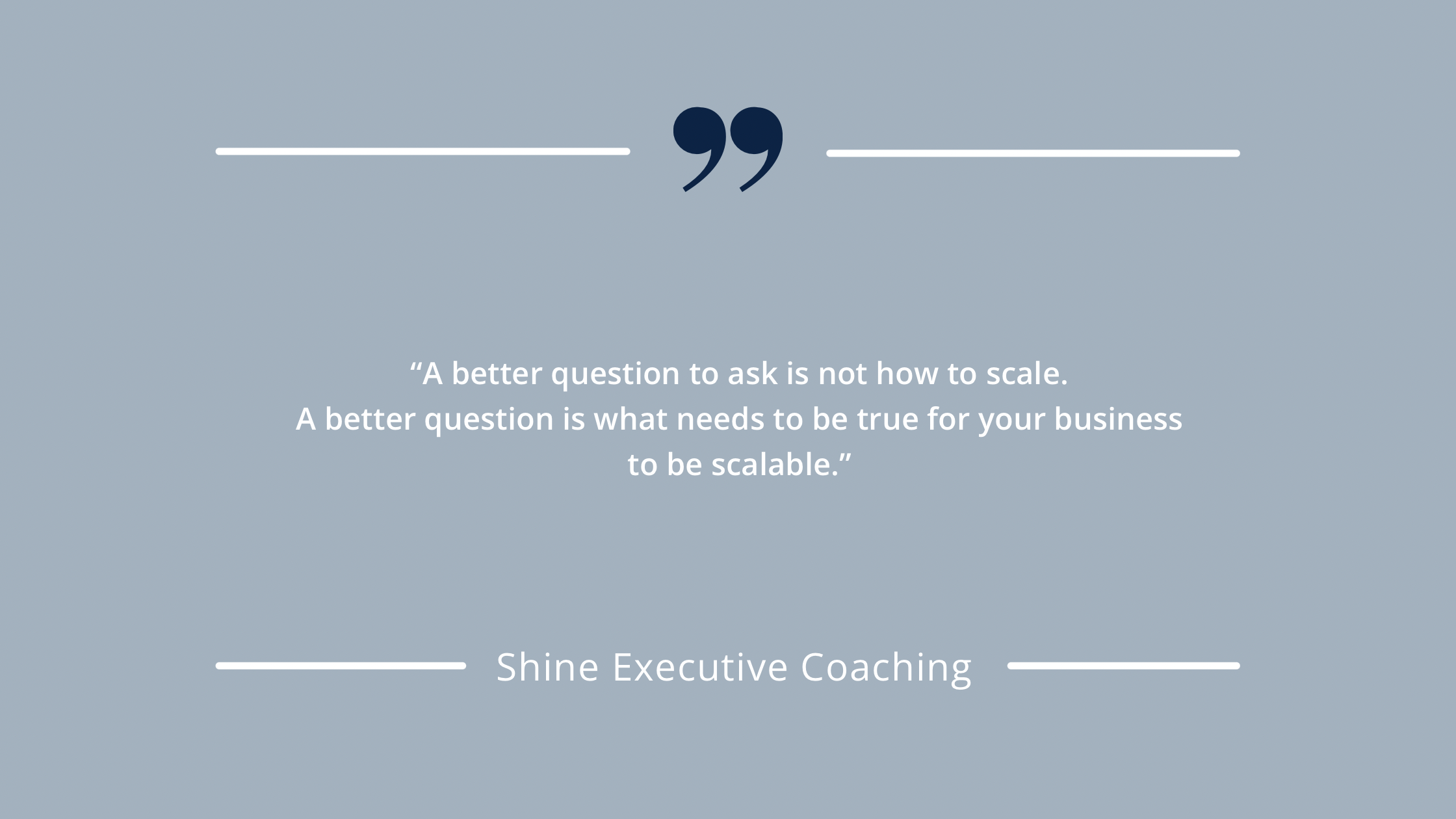
A better question to ask is not how to scale.
A better question is what needs to be true for your business to be scalable.
When those things are in place, growth becomes much more predictable. It becomes something you can lead with confidence instead of something you hope will work out.
If you are in that in-between stage, where you know you have built something meaningful but you are not sure what comes next, this is the work that matters most.
Clarity first. Foundation second. Then growth.
Shine Lesson Learned
Scaling proves what already works. It builds on a strong foundation. When that foundation is in place, growth becomes a strategy instead of a risk.
Shine On,
Shannon ✨
PS: If you’re reading this and realizing your foundation needs strengthening before you scale, you’re not alone. This is the work I do every day with founders who are building something meaningful and want to grow it the right way. If you want help getting those pieces in place, I’d love to have a conversation.